
Paola Martire
The detection and characterisation of Tidal Disruption Events (TDEs) represents a unique powerful tool to investigate the demographics of Massive Black Holes (MBHs), allowing us to study their formation and growth.
These transients happen when a star approaches an MBH and is torn apart by tidal forces, releasing an amount of energy comparable to that of a SuperNova.
Since current and future (LSST, ULTRASAT) surveys are able to detect TDEs, having a robust physical model to describe them will allow to constrain the involved (few) parameters, such as the mass and the spin of the MBH and the mass of the star.
Our goal is to model, through theory and numerical simulations, the early-time emission of these events – the brightest, most easily observed, and most hotly debated emission component – deriving observables for future comparison with observations.
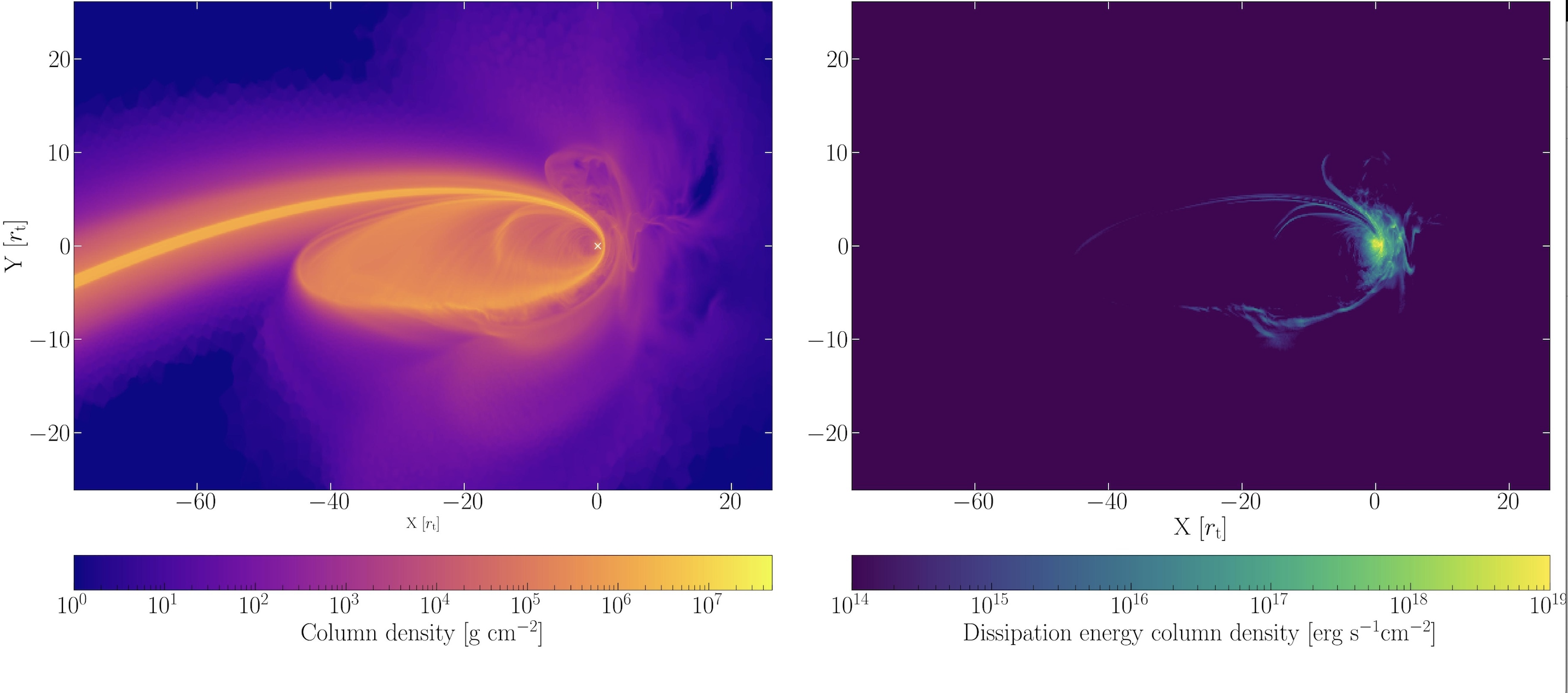
Look at the full evolution here: https://drive.google.com/file/d/1O1hBeL4FR1HiaQv0eWrs4nB9y48gH8Nl/view?usp=share_link
TDEs from Intermediate-Mass Black Holes (IMBHs; i.e. BHs with masses between 1e4 and 1e6 solar masses) are of particular interest, as their detection and characterization would prove the presence of these elusive mid-weight compact objects, and would provide an observational bench for testing MBH formation models. In addition, they offer greater computational tractability in numerical simulation, which makes it possible to conduct more rigorous convergence tests by comparing runs with different resolutions.
In my work, I analyzed the first 3D end-to-end simulation of an IMBH TDE with the radiation-hydrodynamics code RICH, alongside with theoretical modeling.
Eddington-limited emission
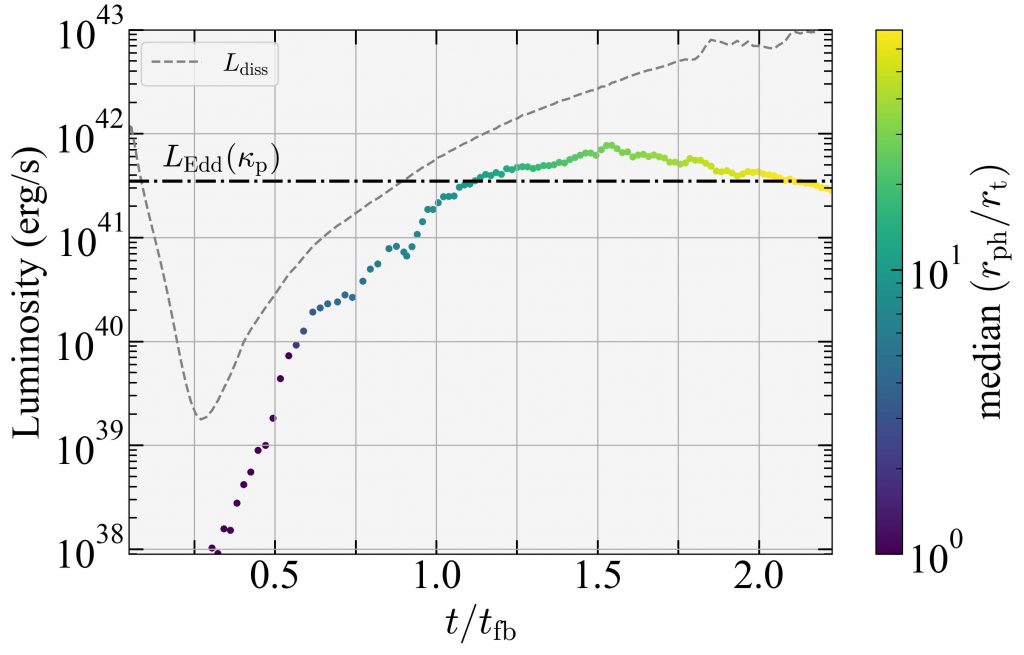
In the first project, we focused on deriving observables and assess the robustness of our results through convergence tests. We found that the stellar debris fails to circularize efficiently, while a low-density, radiation-driven wind forms near pericenter and expands quasi-spherically. The emitted radiation is advected by this outflow and released at the photosphere, which expands to radii of 1013 cm and reaches temperatures of few times 104K at the peak of the light curve (at 1.5 fallback time, i.e. ~5 days). The resulting bolometric luminosity briefly exceeds the Eddington limit before settling near that value.
Check the paper here
Wind analysis
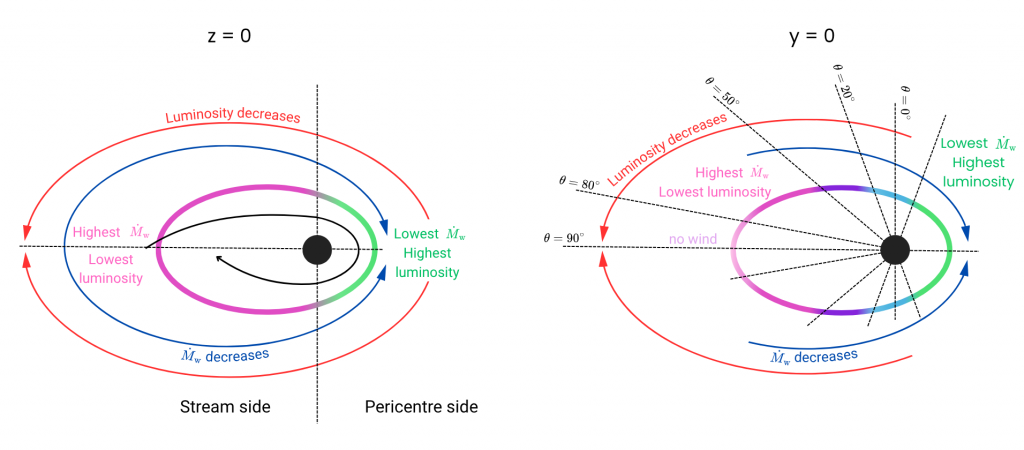
We further investigated the outflowing material, characterizing its time- and angle-dependent geometry and physical properties. Outflow anisotropy produces viewing-angle-dependent observables, with the polar and pericentre regions being more luminous and the stream region denser and dimmer.
Check the paper (under review) here
Polarization
Currently we are working on characterizing the time- and angle-dependent polarization in our simulation, with the goal of developing a semi-analytical model to describe the shock-induced polarization in TDEs.